Author

James Lewis

Browsing

Last week I had a detailed Arduino tutorial on software pulse width modulation using millis() and micros(). Why? Because I wanted to create a Proper Larson Scanner, with persistence and at least 8 LEDs.

KITT larson scanner example
From Amazon

Even though it is a popular project for the Arduino Uno, most Larson scanner tutorials, like my first one, have a few flaws. First, there is no persistence, or tail, to the LED as it moves back and forth. Persistence could be solved by using pulse-width-modulation. The Uno and other 328p-based micros only have 6 Pulse Width Modulation (PWM) pins. And let’s be honest, every project is made better by adding more LEDs. 🙂

If you look at this cover shot of KITT from Knight Rider you will see there isn’t just a single light source. It appears multiple lights are turned on, as well as fading effect. This fading effect creates a tail. Of course, the reason is probably that standard light bulbs were being used back in the 80s. Traditional light bulbs don’t turn on or off nearly as fast as LEDs.

Presenting the Proper Larson Scanner

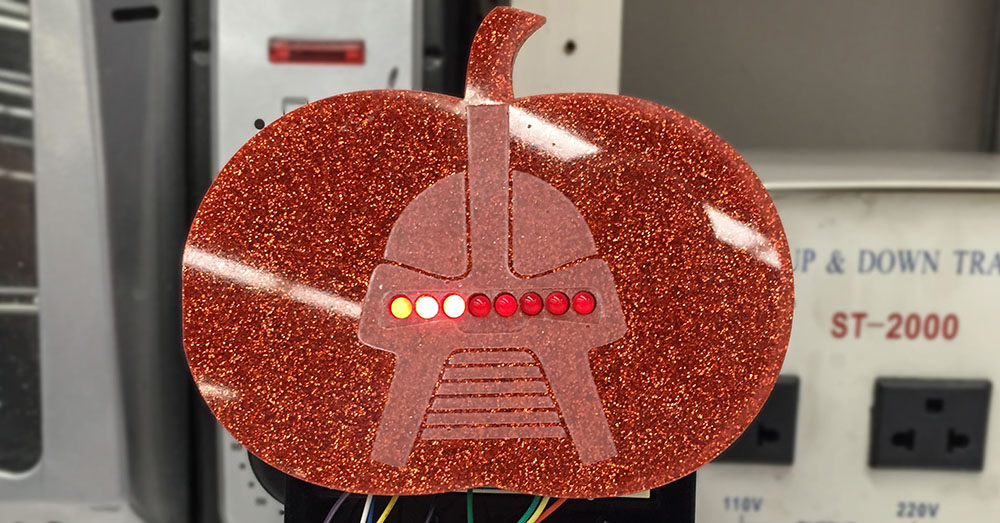
Knowing that a popular Halloween hack is to add Cylon (or KITT) lights to your pumpkins, I thought it was time for a Proper Larson Scanner. This code example does a couple of important things.

  1. It implements my “software pulse width modulation.”
  2. Can be used on all 20 I/O pins of an Uno (or other 328p Arduino)
  3. Does not use any delay()s!

So if you want to make your pumpkin even more Cylon-like this Halloween, check out this full tutorial on a proper Larson scanner.


While I was attending a material science conference, I learned the value of listening to something new. The paper I came to see was finished, and the next was about to start. It was titled, “Additive Manufacturing.”

I almost left!

What a dull phrase, right? Well, I was stuck in the middle of a row with four people on either side of me. So I decided, it was a good time to catch up on Reddit. What I didn’t realize is “additive manufacturing” is what almost everyone else in the world calls “3D Printing.” Plus, this presenter was talking about doing it with metal!

When you think about it, most extrusion-based 3D printers are laying down material one layer at a time. In other words, they are manufacturing an object by “adding” material. See the connection? Most people probably lump 3D-printing into rapid prototyping and additive manufacturing into a “real” production process.

One more story.

At SXSW one year, I attended an event held by Shapeways. Objects they made were all over the venue, and they looked incredible. Plus, some were for sale. My favorite? Super Mario Bros related stuff. Do a search for “Mario” in Shapeways marketplace for some neat things to add to your desk.


The Engineering Commons Podcast LogoThe awesome hosts on The Engineering Commons (TEC) podcast asked me to join them on Episode 93-Capacitors! They told me I was the first passive component expert they had on their shown. It was a blast talking to Jeff, Carmen, Brian, and Adam.

The unique thing, in my opinion, about The Engineering Commons is that it covers multiple engineering disciplines. A couple of episodes ago, they talked traffic. Since I am about to move, the episode on Garage Setups was great.

When I put together my list of 5 electrical engineering podcasts, I didn’t include TEC. Which was tough because it is a great podcast, and worth adding to your favorite podcatcher.

If you want to hear my answers to some common capacitor questions, check out The Engineering Commons Podcast Episode 93: Capacitors. For a more in-depth interview, don’t forget about The Spark Gap Episode 25 where I go into a bit more detail about capacitor types.

moon from apollo project archive
Image via Project Apollo Archive Flickr

Years of hard work, curation, and archiving have brought the Project Apollo Photo Archive to a Flickr album. Kipp Teague writes,

“This new Flickr gallery would have not been possible without the support of Mike [Gentry], Steve [Garber], and Eric [Jones], and many others.”

In this note, he corrects a misconception that this archive itself was an NASA undertaking. While the photos come from NASA, the archive is an independent effort.

There is also a Project Apollo Archive Facebook page, in addition to the photos on Flickr.

The latest video from AsapSCIENCE, The War on Science, addresses the preverbal war between science and society we are experiencing today. 100, 200, or 1000+ years ago you could argue the ignorance of science was due to lack of information availability. However, that does not apply to today’s world. The entire World’s knowledge and the sum of collected data are available to virtually anyone, anywhere at any time. This moment isn’t just historical; it is pivotal. Yet. Society as a whole seems to continue the trend of ignoring this data in favor of emotional social media posts.

AsapSCIENCE’s take on the situation is spot on and worth not only the 5 minutes to watch but also sharing with the video everyone you know, and voting to support science, in your area.

Watch the The War on Science on YouTube.