Category

Blog

Category

If you’re using serial (or UART) communication between two devices and seeing data corruption, there could be a simple fix.  For example you might be trying to communicate between two Arduino boards, using one Arduino Uno as a Serial-to-USB adapter for another board, or have an Arduino connected to a  Raspberry PI.

If you’re getting corrupted transmissions that get worse at lower speeds, double-check you have common grounds between the boards.  Inductive coupling is probably letting the communication work.  Without the common ground though, your transmission is going to be susceptible to all kinds of noise.

Tweet: Remember. Ground is a reference. It needs to be common to everything in the circuit.  http://ctt.ec/l6SX3+Remember.  Ground is a reference.  It needs to be common to everything in the circuit.
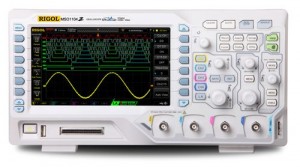

MSO1104Z

Oscilloscopes are the most critical tool when it comes to debug and analysis of electronic circuits.  In recent years, digital oscilloscopes finally surpassed their analog equivalents.  (10 years ago I would still make an argument for analog, but not anymore.)

The most innovative change to digital scopes came with “Mixed Signal Scopes.”  In addition to the high-resolution analog channels, you get 16+ digital channels time-correlated.  Digital channel in this context means only seeing a 0 or 1, kind of like a logic analyzer.

Rigol’s MSO1104Z combined 100MHz of Analog Performance on 4 channels along with 16 Digital Channels for $1000 (MSRP: $997) USD!  That’s an amazing package.  Full specs and Quote request available here.

From Jan 1 2014 until today, baldengineer.com’s traffic has increased 150%.  With so many new readers, I thought about how to make better posts for you.  That lead me to look at the top posts in 2014. Below are the most viewed posts from the past year, plus some honorable mentions.

Top 10 Posts from 2014

  1. 5 Myths Everyone Believes about Arduino (that aren’t true)
  2. millis() Tutorial: Arduino Multitasking
  3. Arduino: How do you reset millis() ?
  4. MSGEQ7 Simple Spectrum Analyzer
  5. When do you use the Arduino’s Serial.flush()?
  6. Arduino: Sending and Receiving Multi-Digit Integers
  7. Arduino Internal Pull-Up
  8. LED Basics
  9. Open Vapors – Open Source Toaster Reflow Oven – Overview
  10. Alternatives to Arduino’s Serial Monitor

One of the best ways to describe a transistor is as an “electronic switch.”  They are solid state devices that make up almost everything in our world.  This video by Veritasium, which is a bit older, covers how n and p-type transistors actually work.

This complements the Addohms videos on BJTs and MOSFETs, which are more about how to use them.

If you’ve never watched a Veritasium video, do yourself a favor and set aside a few minutes. He’s like the Alton Brown of science.