Category

Blog

Category

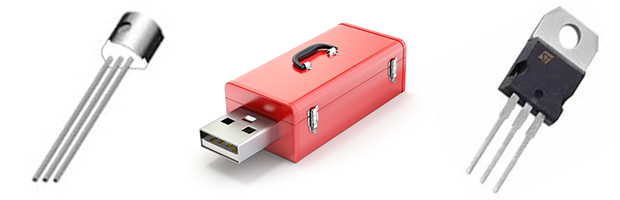
When your project needs a transistor, there are tons of choices.  Which makes answering the question “Which transistor should I use or buy?” a daunting task.  Fear not, before wading through spec sheet after spec sheet, consider one of these four general purpose transistors.  Every electronics enginerd’s toolbox should have a few of each.

Transistors are one of the most versatile discrete components in electronics.  In digital circuits, they switch on and off while in analog circuits they are used to amplify signals.  For most projects, they are used to turn on a load that would kill the I/O pin of a microcontroller or microprocessor.   For most circuits either a BJT or MOSFET can be used, depending on the load current you need to switch.

[Edit Note]  Jan (comment below) points out that there are European Equivalents that may be more available for those located in that part of the world. For NPN Check out the BC547, for PNP the BC557.

Here are some more details on each of these.

What does Silicon have to do with Social Media?  Silicon’s Atomic Number is 14.  Wait what?  Oh… element14 is, basically, a social media site for electrical engineers, embedded designers, makers, and hobbyist.   Forums, blogs, videos, and all kinds of resources from “celebrities” around the EE world.

It’s one of the most active communities and, in my opinion, one of the cleanest layouts.  Over the past few months, I’ve been becoming more active there.  If you’re there, check out my activity feed and add me as a contact!  It’s a great way to stay in touch.

Note that I don’t have an affiliation with element14, other than being a member, just like you can be.

When most people say “Arduino” they mean an ATmega328 based board like the Uno.  This means a simple 8-bit microcontroller with only 2K of RAM.  That’s 2,048 bytes of memory to work with.  So when someone asked me if the Arduino could do speech recognition, to be honest, I laughed.  Then my jaw dropped when I saw µSpeech.  A speech recognition library for the Arduino Uno’s ATmega328.

Each year it is fun to see who gets “got”.  With Twitter fever getter hotter each day, people can’t help but spread juicy news details.  Here’s a running list of the April Fool’s Gags I ran across in 2014 (updated links at top of list)

In the past couple of months, AddOhms has caught a little bit of a following.  Nearly every day I have new questions coming my way.  I decided to it was time to address a couple of really good questions in a video response.  Ironically, in the video I mentioned giving “behind the scenes” info with each video.  However, for this one, I don’t really have any.  I can say that the next video is going to be on transistors…