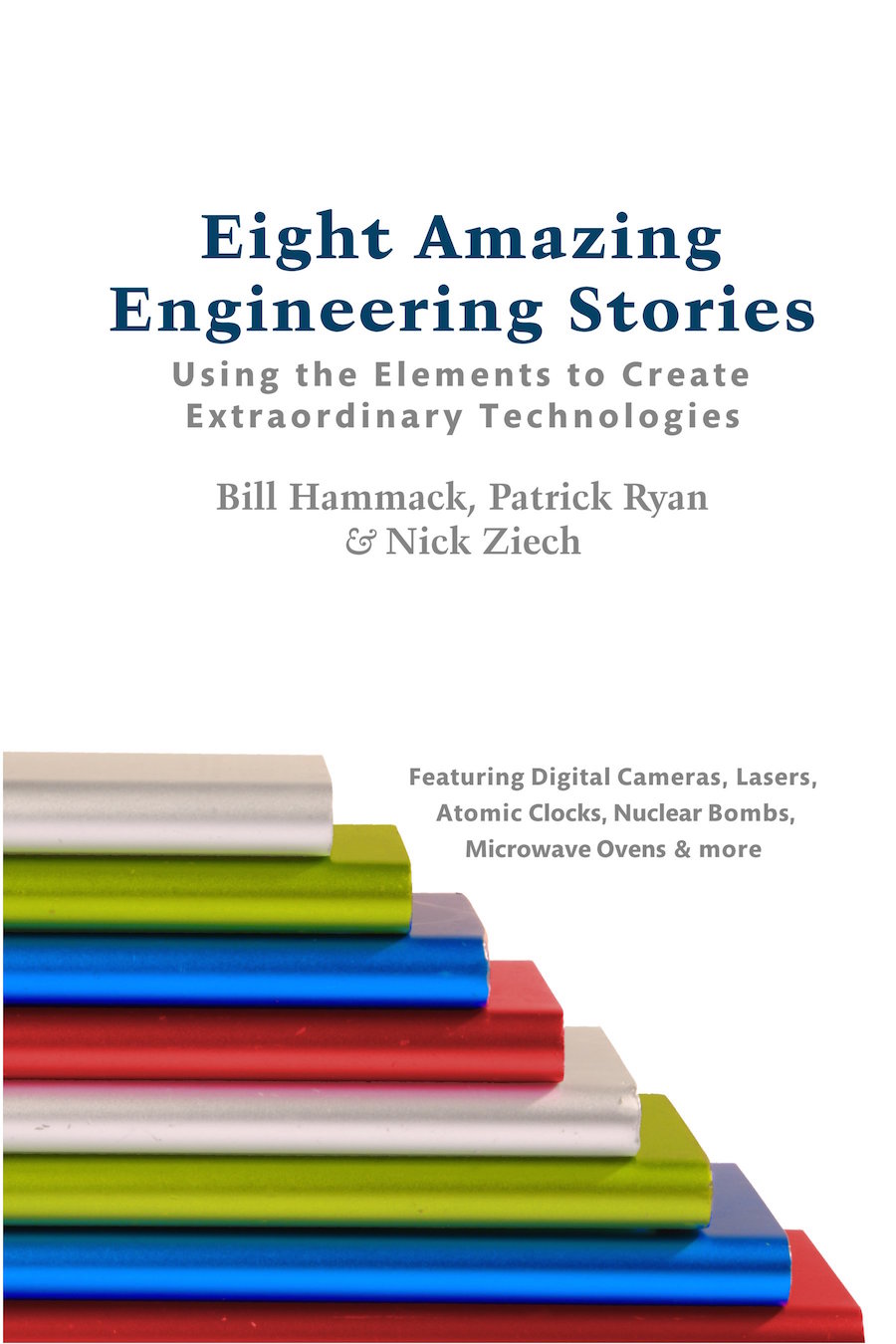
Bill Hammock’s “Engineer Guy” podcast series was one of my first video podcast subscriptions.  His explanation videos hit the right balance between “high level’ and “low-level” details in a few short minutes, which was actually an inspiration for the format of AddOhms.  With each of his videos, you will learn something and get a few laughs–which is rare for engineering related videos.

His book, with co authors,  “Eight Amazing Engineering Stories“, was added to my Kindle App as soon as it became available.  The book breaks down everyday objects and technologies down to their science and engineering fundamentals.

Let’s be honest, nothing here is something you can’t find on Wikipedia.  However, what you won’t find is the awesome presentation style, a trademark of Hammock.

If you want to know how elements like Silicon, Cesium, and Tungsten have made their way into our lives.  Or how Atomic Clocks, Microwaves, and Accelerators work–along with their back story, this book is for you.

Whenever I have a few minutes to fill, I find myself scrolling around the book to pick up new tidbits.

Review: 5 out of 5 LEDs
Review Rating: 5/5 LEDs

Overall, I give this effort a 5 LED review.  It’s not an expensive buy and deserves a place on any enginerd’s shelf, virtual or otherwise.

Article I wrote on some innovations KEMET has implemented in their capacitors:

There is no Moore’s Law for passive components like capacitors, but relentless development is delivering the kinds of devices engineers need to deliver cutting-edge new products for modern living. Capacitors have for many years enabled electronic designers to manage energy within circuits and fulfill basic functions like filtering noise or harmonics, correcting power factor, stabilizing feedback circuitry, coupling/decoupling, interfacing between voltage levels, and storing energy. But the demands placed on these components continue to increase, as electronic devices are expected to be smaller, longer lasting, more feature rich and more robust.

Read “Capacitor Innovations Address Emerging Opportunities” on Power Systems Design.

What happens when you have a random chip or sensor you want to interface with an Arduino, but don’t know how? You search for a pre-existing library of course. And where are many libraries hosted and available from?  A place where eager developers hack together code, post updates, and collaborate with others: Github!

If you’re using serial (or UART) communication between two devices and seeing data corruption, there could be a simple fix.  For example you might be trying to communicate between two Arduino boards, using one Arduino Uno as a Serial-to-USB adapter for another board, or have an Arduino connected to a  Raspberry PI.

If you’re getting corrupted transmissions that get worse at lower speeds, double-check you have common grounds between the boards.  Inductive coupling is probably letting the communication work.  Without the common ground though, your transmission is going to be susceptible to all kinds of noise.

Tweet: Remember. Ground is a reference. It needs to be common to everything in the circuit.  http://ctt.ec/l6SX3+Remember.  Ground is a reference.  It needs to be common to everything in the circuit.