Author

James Lewis

Browsing

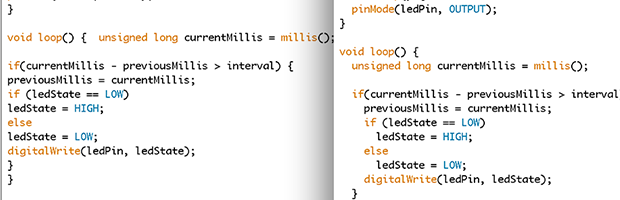
Warning, the title of this post is a little bit misleading. It isn’t just one-click to get cleanly formatted code, it’s actually two.

There are two things seasoned programmers will tell new programmers, that they don’t understand (at first):

  1. Always comment your code
  2. Properly indent code

The problem?  As a new programmer, you might not know how to do #2 until you get some experience.
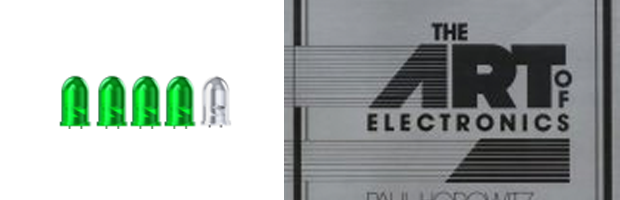
Title:  The Art of Electronics by Paul Horowitz and Winfield Hill.


Most electronics books are written by engineers, for engineers.  It is difficult to find an extremely comprehensive book which covers most Electronics subjects that is written in plain english.

This is that book.

Every Addohms project follows the same pattern.  About 80% of my original idea makes it into the video while the remaining 20% I make up on the fly.  Of course, when I do that, I spend 80% of my time on that 20%.  AddOhms #10 on BJTs is no different.

For now, there is going to be a two part series on transistors.  #10 is the first part of this two part series.  We cover BJTs here and will cover MOSFETs in the next one.  (And hey, that one is already 20% written!)

Check out Addohms.com or the AddOhms YouTube Channel for more videos.

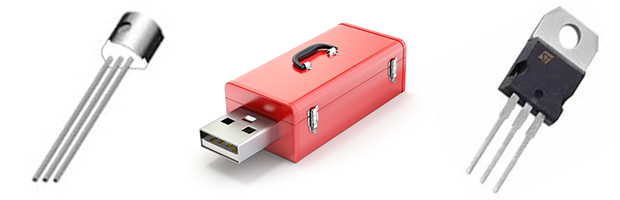
When your project needs a transistor, there are tons of choices.  Which makes answering the question “Which transistor should I use or buy?” a daunting task.  Fear not, before wading through spec sheet after spec sheet, consider one of these four general purpose transistors.  Every electronics enginerd’s toolbox should have a few of each.

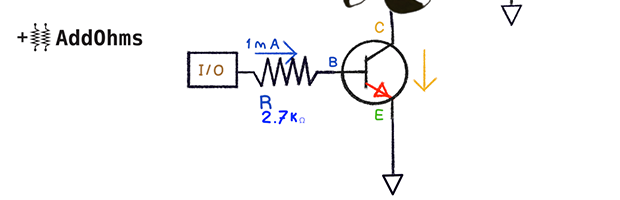
Transistors are one of the most versatile discrete components in electronics.  In digital circuits, they switch on and off while in analog circuits they are used to amplify signals.  For most projects, they are used to turn on a load that would kill the I/O pin of a microcontroller or microprocessor.   For most circuits either a BJT or MOSFET can be used, depending on the load current you need to switch.

[Edit Note]  Jan (comment below) points out that there are European Equivalents that may be more available for those located in that part of the world. For NPN Check out the BC547, for PNP the BC557.

Here are some more details on each of these.

What does Silicon have to do with Social Media?  Silicon’s Atomic Number is 14.  Wait what?  Oh… element14 is, basically, a social media site for electrical engineers, embedded designers, makers, and hobbyist.   Forums, blogs, videos, and all kinds of resources from “celebrities” around the EE world.

It’s one of the most active communities and, in my opinion, one of the cleanest layouts.  Over the past few months, I’ve been becoming more active there.  If you’re there, check out my activity feed and add me as a contact!  It’s a great way to stay in touch.

Note that I don’t have an affiliation with element14, other than being a member, just like you can be.