Category

Around The Web

Category

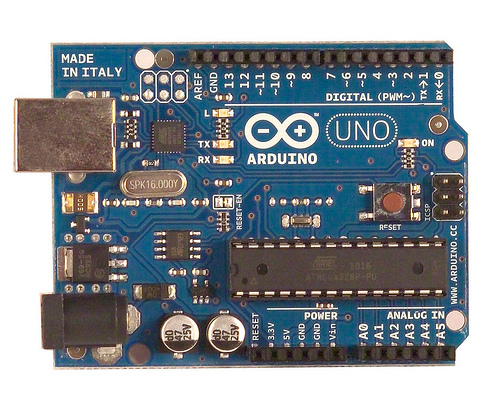
Arduino UNO with Annotations

westfw of the Arduino Forums has put together a nice Flickr Annotation of the New Arduino UNO. A couple of changes have been made from the previous Duemilanove. Interestingly they have left pads for either a crystal or resonator on the board. This may allow the end-user to use a crystal for more accuracy without adding additional cost for everyone else.


Random numbers are a relative concept. In general, random numbers used in digital electronics are called Psuedo-Random sequences. There is a defined algorithm that is used to generate the sequence and does not actually occur in nature. In applications like Flashing a LED, this method is fine. However, for any level of encryption this is unacceptable.

Steve Buch at Electronics Weekly writes about how researchers Dr. Marie O’Neill and Dr. Jiang Wu at the University’s Institute of Electronics and Communications Information Technology (ECIT) has developed methods to generate true random bits digitally.

Fundamental to all of the ECIT generators is the effect of random noise during the transition from a metastable state to a bistable state.

Whether the output becomes a 0 or 1 depends on conditions, including internal noise, at the instant of input transition.

If you are giving thoughts to creating a cryptographic device, you might want to give their methods a look.


One of the major feature updates for the iPhone 4 included a gyroscope.  There are two applications that a gyroscope can be used for:  keeping an object in balance and providing precise positioning data.  Obviously, the intended application in an iPhone is improved positioning and control of software objects.  One of the questions I had about the iPhone 4 was whether there was something (very tiny) spinning inside of the iPhone or if the device was solid state.  Until now, I had no idea that solid state gyroscopes existed.  Engineers at iFixIt, with help from Chipworks‘s Electron Microscope, have done a teardown of the iPhone 4’s MEMS based Gyroscope.

The pictures and lessons on how Gyroscopes work is fascinating.  Their article not only educates on how Gyroscopes work, but compare a spinning gyroscope to a MEMS based gyroscope.  The summary is, the iPhone and compact mobile devices like it, are packing some of the highest levels of technology we have on our planet.  Think about that the next time you are sending someone “just a txt.”

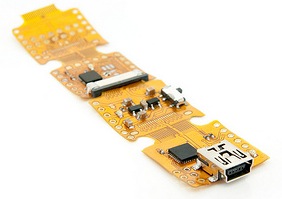
FPC ArduinoThe folks over at Seedstudio have created a first for Arduino:  a FPC version!  In the past, it was very common for this material to be used as interconnects between circuit boards in production products.  The flexibility makes it simple to use and the ability to attach components directly saves space.  These are just prototypes, but Seeedstudio is looking for ideas to help move into higher volume production.  Who is going to make the first Arduino watch?

Electronic communications systems are made up of three basic components: a transmitter, a receiver, and a transmission medium. Use a video game system with a wired controller as an example. The controller is a transmitter, while the console is a receiver, and the wire that connects the two is the transmission medium. This wire is typically made up of copper. The distance from a couch to your tv is relatively short compared to the distance two continents separated by an ocean. For this distance fiber optic cables are used. Instead of electrical signals being transmitted, lasers are used to generate light across fibers of glass.

Until recently, to transmit 1s and 0s the laser would turn the light would be pulsed on from an off state. Researchers at the National Institute of Standards Technology (NIST) and the University of Colorado have reversed the process and have successfully generated a series of “dark pulses.”

Any transmission medium will have irregularities which disrupt communications. What the researchers have found is that by sending Dark Pulses they can minimize the irregularities typically found in Fiber.

According to the lead researcher, Richard Mirin of NIST, it will be a few years before this technology makes it into the commercial marketplace.

More information can be found in this article at PhysicsWorld.