Category

Around The Web

Category
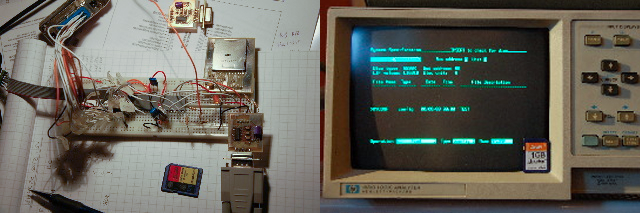
Images from http://www.dalton.ax/hpdisk/

Popular on eBay are old test equipment like Spectrum Analyzers, Oscilloscopes, and Multimeters. HPDisk by Gustafsson Anders creates a virtual GPIB interface that stores data to a SD-Card.This is done by emulating a special HP disk drive, that some HP instruments know how to write to when connected. (As Anders points out, this is not emulating a built-in floppy drive.)

Keep reading if you aren’t familiar with GPIB.

What’s GPIB?

Long before USB became the standard I/O interface in the computing world, bench-top instruments used HPIB. This was the “HP Interface Bus” used by Hewlett-Packard in the early days of their test equipment. It enabled instruments to share data and be automated by “desktop computers”.

Eventually HPIB evolved into GPIB and the IEEE-488 standard was created. Until about 2000, most instruments supported a true GPIB/IEEE488 hardware connector. Slowly that evolved into USB-based virtual connectors (like a virtual serial port).

Go back to 1975. The idea of a computer at home was something that only happened in Science Fiction books. When the Altair 8800 was introduced, not only could you have a computer at home–you could build it yourself!

For some “computer” is a bit liberal. Based on the Intel 8080, the “computer” supported some toggle switches and LEDs on the front panel.  As Gates explains in this video, there wasn’t even any kind of interactive terminal.

Check this MAKE article on the history of the Altair 8800.

Having good libraries in EAGLE is critical to making schematic capture and PCB design fast.  Dave at element14 put together a top 10 library link, which includes the list below.

Remember, if you’re having trouble Add Parts, you might want to look at this tutorial on enabling EAGLE libraries.

  1. element14’s RIoTBoard
  2. element14’s Raspberry Pi Compute Module Development Kit
  3. element14’s BeagleBone Black
  4. Linear Technology
  5. Molex
  6. Vishay
  7. Microchip
  8. Atmel
  9. Arduino
  10. Texas Instruments

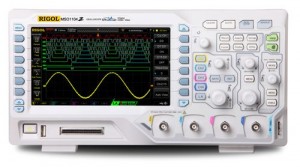
Oscilloscopes are the most critical tool when it comes to debug and analysis of electronic circuits.  In recent years, digital oscilloscopes finally surpassed their analog equivalents.  (10 years ago I would still make an argument for analog, but not anymore.)

The most innovative change to digital scopes came with “Mixed Signal Scopes.”  In addition to the high-resolution analog channels, you get 16+ digital channels time-correlated.  Digital channel in this context means only seeing a 0 or 1, kind of like a logic analyzer.

Rigol’s MSO1104Z combined 100MHz of Analog Performance on 4 channels along with 16 Digital Channels for $1000 (MSRP: $997) USD!  That’s an amazing package.  Full specs and Quote request available here.