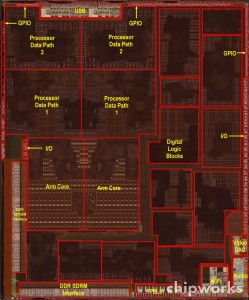
Apple’s latest magic trick was upgrading their previous A4 chip into a dual core variant, the A5. This chip powers the recently announced iPad 2 and is likely to be in the upcoming summer release of the iPhone 5 (4s?) The folks at Chipworks have done some reverse engineering (which may be using actual magic) to see what the inside of the A5 looks like… all 2.9Million gates of it.
Coming Q3 of 2011, ST-Micro will begin selling a Single-Chip GPS IC called the Teseo II. It has an ARM core integrated into it, which should help reduce the time it takes to get a fix, and simplify integration into any hardware project.
Pricing is set at $6 in volumes of 500k, so for hobby work it may be a cost/time trade-off.
ST selling single-chip GPS IC. – 1/27/2011 – Electronics Weekly.
On the Janurary 15, 2011 edition of Adafruit’s “Ask An Engineer” live video chat, I heard LadyAda mention something about “Arduino Amnesia.” After investing the situation a little further, it turns out there are some Issues with the new Arduino UNO Smd edition.
A bug in the new bootloader can be triggered on power-cycle causing the SMD version of the board to not load the previously stored sketch. The good news is there is already a fix for the bug. Either return the board to your Official Distributor or use a ISP to program the new bootloader.
Issues (if I could even use that word) like this makes Open Source Hardware fun!
From the company that brought us, “There is a worldwide need for no more than 5 computers”. IBM is announcing 5 Innovative Technologies we will see over the next 5 years.
In summary they are:
- 3D Communications
- Batteries that use air to recharge
- Citizen Scientists (Sensors Everywhere!)
- Personalized Commuter Information
- Smarter Energy Grid
Engineers at Yelp have put together an Arduino and iPad controlled Keg-o-rator. By swiping their RFID they can track how much a person is drinking, collect statistics about how others enjoyed the beer (by rating it), and maintain a leader-board of the office. Everything used in the project is based on off-the-self components. My guess is that they are communicating between the iPad and Arduino over the iPod Dock’s i2c interface. It looks like they are using the PodGizmo iPod Dock Conntector Breakout board available at Kinetka Systems. Drink up!